
How to Search Criminal Dockets
Begin with the court named on the citation, bond paper, notice, or case caption. Felonies belong in the District Clerk collection. County-level misdemeanors are routed through the County Clerk and one of the five County Criminal Courts. Fine-only matters may instead be held by one of six Justice Courts or by a municipal court. The official Judicial and Law Enforcement Records Search hub helps separate these records before a name search begins.
Use a cause number when one is known. Names can match more than one person, while the cause number and assigned court identify one file. If online Public Access is unavailable or does not show a permitted record, the District Clerk accepts the prescribed request through its counter, mail, fax, or email channels. Public computers are also available in the District Clerk and courthouse lobbies.
- Identify felony, county misdemeanor, Justice Court, or municipal jurisdiction.
- Open Denton Public Access and choose District Court Case Records and Calendar for a felony.
- Search with the cause number, or use a full name plus the assigned court.
- Read the settings and event history without treating one row as the whole case.
- Ask the correct clerk for a plain or certified copy when proof is required.
Denton County Felony Docket Clerk
The District Clerk is the registrar, recorder, and custodian for Denton County district felony causes. Its felony and magistrate records line is 940-349-2210, with fax service at 940-349-2211. A formal Felony Case Record Search form asks for a full name and minimum identifying data, along with current state identification. The published charge is $5 per search and certificate, and the form says to allow up to ten business days for completion and certificate mailing.
That timetable applies to this formal search, not to every docket update. The clerk may also receive a request in person at 1450 E McKinney Street, by mail to P.O. Box 2146, Denton, Texas 76202, or through dcrecords@dentoncounty.gov when the clerk's instructions permit. Statewide re:SearchTX can provide another access layer, but its account and document rules do not replace the official Denton County file.
The official District Clerk directory shows the separate felony and civil-family contact rows.
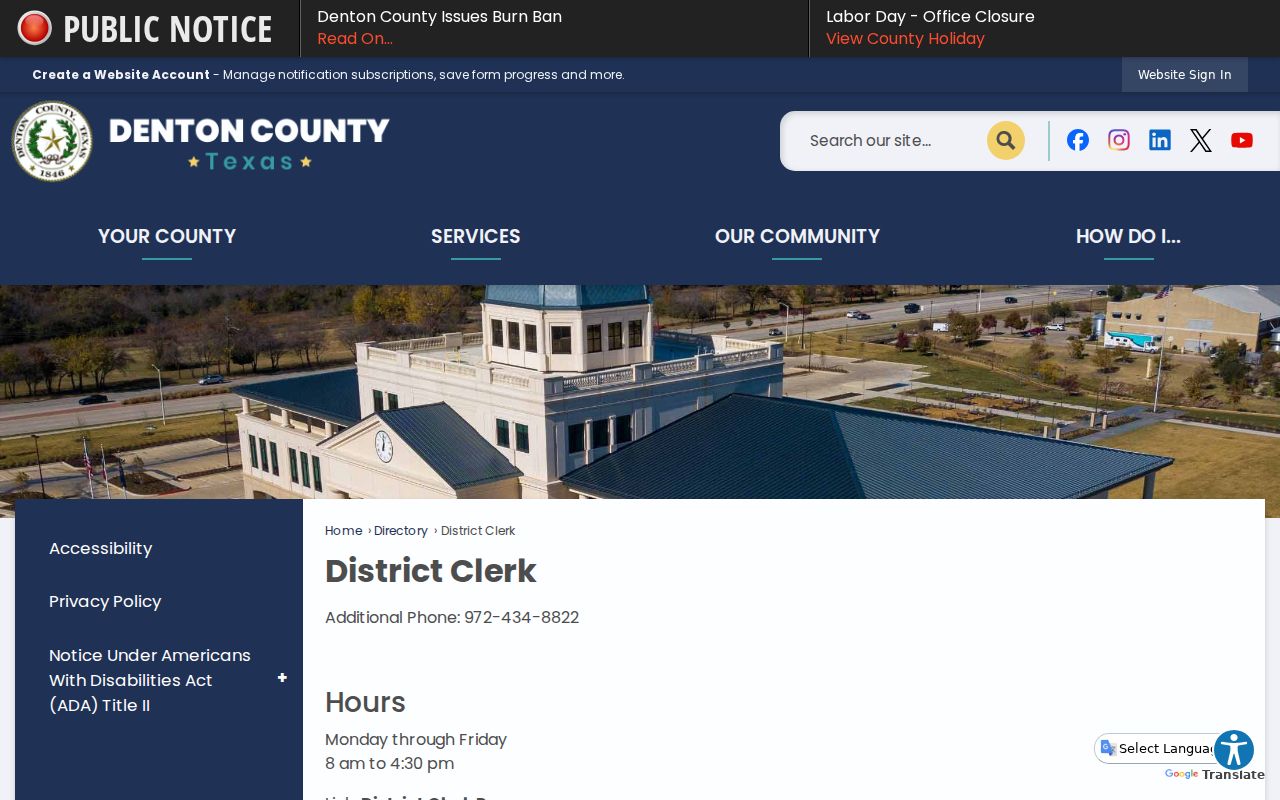
This division is why a felony record request should not be sent to the County Clerk's misdemeanor desk.
What a Criminal Docket Shows
A Denton County criminal docket is a chronological registry, not a single judgment. It can show when the case was filed, which court now holds it, the charge description, bonds or initial settings, later hearings, motions, pleas, and disposition events. A visible event does not guarantee that its underlying image is open online. Likewise, an absent image does not prove that no paper was filed.
| Cause number | The court identifier, such as court-assigned cause number, used to distinguish the file. |
|---|---|
| Charge | The alleged offense and level; it is not itself a finding of guilt. |
| Setting | An arraignment, pretrial, plea, trial, or sentencing date. |
| Plea or order | An event entry that should be checked against the filed document. |
| Disposition | The court's recorded result, which may require a certified copy for official use. |
Denton County Criminal Docket Identifiers
The formal felony search asks for enough data to distinguish people with similar names. That requirement protects search accuracy. It also makes a cause number, court name, and full legal name far more useful than a broad name-only query.
Denton County Magistrate and Felony Dockets
The Magistrate Court publishes dated morning and afternoon weekly docket PDFs. Those lists can help confirm an initial hearing or bond-stage event. They are snapshots, not a complete felony registry. A person may appear on an initial magistrate list before a district felony cause is filed, and the term “unfiled criminal” describes that stage rather than a final outcome.
For later motions, settings, pleas, or a disposition, return to the District Clerk registry and the assigned district court. The weekly docket index should always be read with its date and session label. An omitted row does not prove that no case exists, and a listed row does not establish a conviction.
The official docket index shows how Denton County separates session publications from the continuing case file.
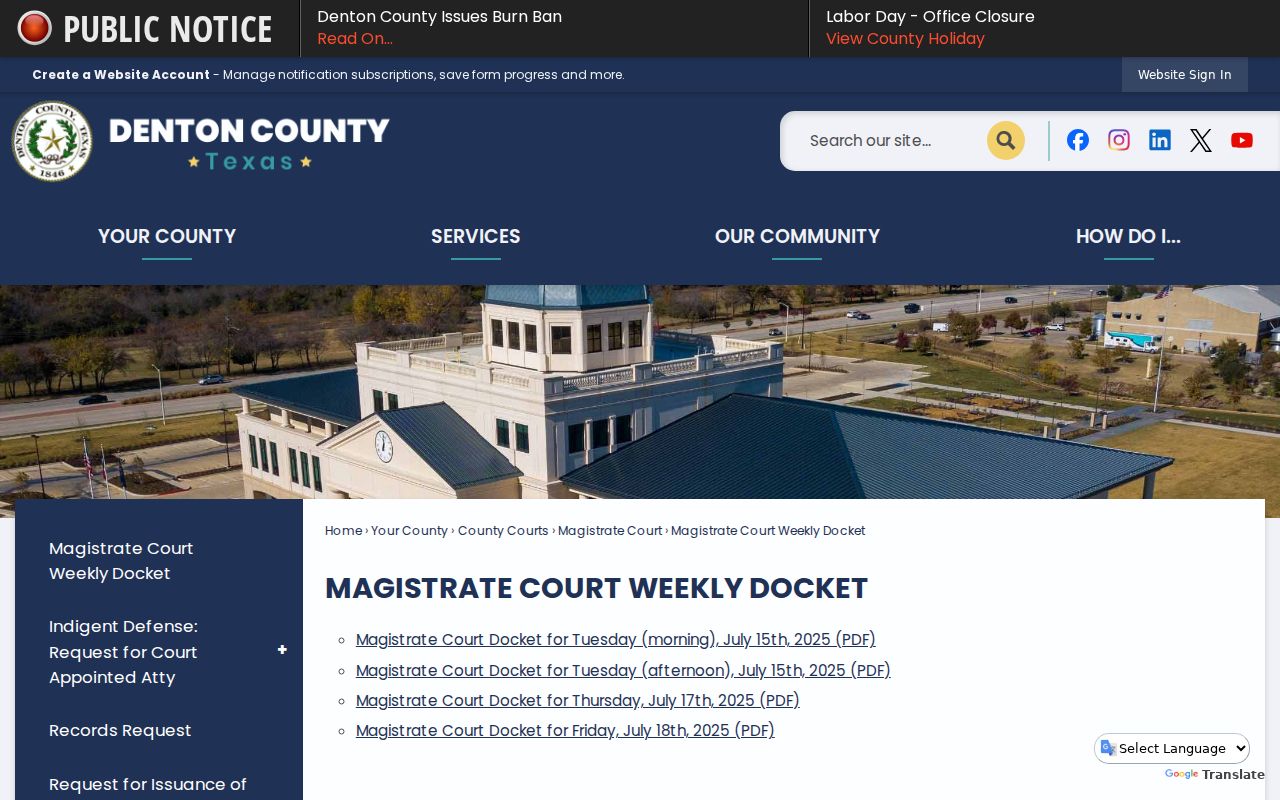
The date and morning or afternoon label should be saved with any citation to a weekly docket.
Stages on a Criminal Docket
A felony record may begin with an arrest-stage magistrate entry, then move to filing or indictment, arraignment, pretrial settings, motions, plea or trial, and disposition. Not every matter follows each step, and resets may add several entries without resolving the case. County misdemeanors follow their own county-court path. A proposed order also is not a signed order: Denton County advises checking proposed-order status after three business days, while noting that clerk delivery cannot guarantee judicial review.
Docket flow: Charge Filed › Arraignment › Pretrial Settings › Plea or Trial › Disposition
Denton County Criminal Docket Filing Timing
An accepted electronic filing is not always a public image at once. Clerk review, indexing, redaction, judicial action, and sealing rules can delay or prevent display. eFileTexas is a filing channel, while Public Access is a reading channel.
Denton County Criminal Docket Transfers
Denton County's Uniform Rules of Court took effect January 1, 2025. They allow the local administrative district judge to transfer criminal, civil, or family cases among district courts to balance work or speed disposition. “Transferred” therefore does not mean dismissed, and it does not create a second criminal cause. It may simply identify a new assigned court.
When a notice and an old search result name different district courts, use the cause number and confirm the current assignment. Court pages and the county event calendar can add setting detail, but the registry remains the best place to follow the file across a transfer. The assigned court controls its hearing schedule.
Which Court Holds Criminal Dockets
District courts and the District Clerk hold felony cases. Denton County's five County Criminal Courts and the County Clerk handle county misdemeanor records. Justice Courts hear their statutory fine-only and traffic matters by precinct. A municipal court keeps city ordinance and Class C cases issued within that city's authority. Federal prosecutions use PACER and the Eastern District of Texas, not Denton Public Access.
The split matters because no single county search is a complete municipal, county, district, and federal criminal index. Start with the issuing court. For county misdemeanors, the Courts Division identifies the correct County Criminal Court. For a JP matter, use the precinct case-access and calendar route. City citations remain with the named city court.
Denton County Criminal Record Copies
A plain emailed copy and a certified paper copy are not the same product. Denton County says plain copies may be emailed, while certified copies are mailed in hard copy. State the needed format before payment and ask the clerk which form applies.
Denton County Restricted Criminal Dockets
Deferred adjudication, deferred disposition, dismissal, nondisclosure, expunction, and sealing are different legal states. A deferred result does not by itself erase the docket. Government Code Chapter 411 and Code of Criminal Procedure Chapter 42A supply distinct rules for nondisclosure and deferred adjudication, while an expunction follows its own statutory process. Searchers should report only the status the official record supports.
Some entries can remain visible while an image is withheld. Other matters can be absent from Public Access because a statute or court order restricts them. Denton County's FAQ states that cases or documents sealed by court or statute are unavailable through the public search. The correct next step is the clerk or an attorney, not a guess based on an empty result screen.
Public Access and Sealed Criminal Dockets
Texas distinguishes court case records from administrative judicial records. The judicial branch is not handled like an ordinary agency under the Texas Public Information Act. A criminal case-copy request normally follows the clerk's case-record process, while Texas Rule of Judicial Administration 12 governs access requests for judicial administrative records. A request should identify the record and custodian with care.
Key Rules:
Texas Judicial Branch Open Records Policy explains the line between court case files and judicial administrative records.
Texas Government Code Chapter 411 covers criminal-history and nondisclosure rules that can limit public access.
Code of Criminal Procedure Chapter 42A governs community supervision and deferred adjudication without equating them with expunction.