
Searching Cases by Name
Begin with the county's own Judicial and Law Enforcement Records Search. It is the safest first stop for a name lookup. For district civil, family, or felony matters, the county points users to Public Access. It also points them to the "District Court Case Records and Calendar" selection. When the interface allows it, narrow the search by court, case type, or filing period. Common names pull up unrelated matters too. So compare the cause number, court, and filing date. Do this before you open any registry entry in a Denton County case search.
- Read the document or citation and identify the named court.
- Open the county search hub and choose the matching collection.
- Enter the party name as the interface requests it.
- Compare court, case type, filing date, and status.
- Confirm a setting or copy request with the clerk.
The live Public Access screen may not always load, and its field order can shift. Treat a field as required only when the screen marks it. When the portal fails, fall back on the District Clerk, the County Clerk, or the issuing lower court for your Denton County case search.
Denton County Case Search Boundaries
Think of a Denton County case search as a routing task. The District Clerk holds district civil, family, and felony pleadings. The County Clerk keeps county civil, misdemeanor, probate, and juvenile court records. Each justice court offers precinct-specific access. Municipal courts run separate city systems.
The District Clerk page lists every official channel. You can search online. You can also call 940-349-2200, email dcrecords@dentoncounty.gov, mail P.O. Box 2146, Denton, TX 76202, fax 940-349-5754, or visit 1450 E McKinney Street. Public computers sit in the clerk and courthouse lobbies. These options matter when a case is indexed but the image is not available.
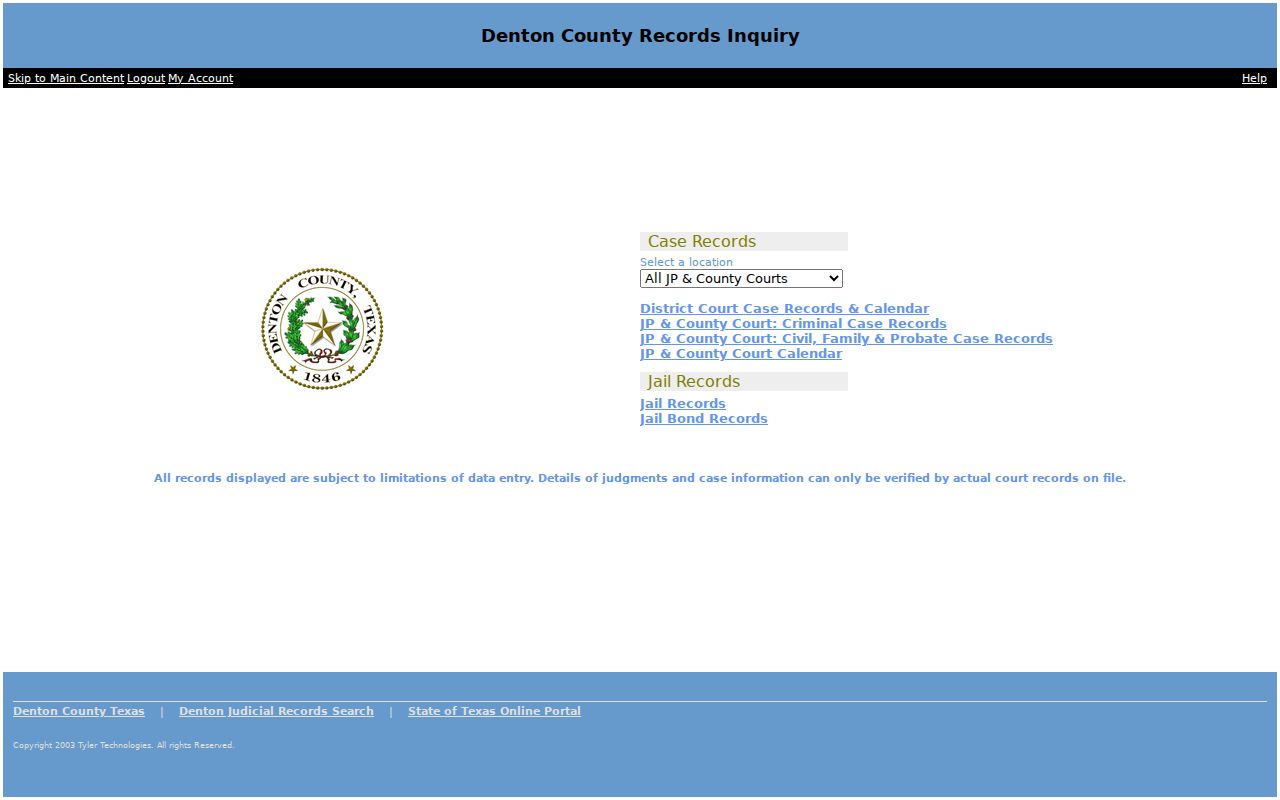
The official Public Access entry is the online starting point for court records.
Searching by Case Number
A cause number is usually the strongest key. It points to one particular court record. No single universal format spans all Denton County trial courts. So treat no invented pattern as official. Enter the exact identifier printed on the notice, pleading, bond paper, citation, or clerk receipt. If the format is uncertain, use court-assigned cause number as a placeholder.
Keep the punctuation at first. If the portal rejects the entry, follow its displayed instructions. Flower Mound tells users to drop the dash and the number after it for its municipal citation portal. That city rule does not transfer to district cases. A number with no match may simply belong to another clerk, precinct, city, appellate court, or federal system.
Denton County Case Search Transfers
Under the county's Uniform Rules, effective January 1, 2025, the local administrative district judge may transfer civil, family, or criminal cases among district courts. The judge does this to balance caseload or speed things along. That means the court where a case was filed may not be the court hearing it now. Search by cause number. Read the transfer entries rather than trusting an old court name.
The Denton Uniform Rules set out this local framework. A transfer is not a dismissal, a new suit, or a final result. Current District and Family Courts notices also flag transfers involving named courts. That makes the assigned-court field a vital part of any Denton County case search.
What a Case Search Returns
The county FAQ calls the chronological display a "registry of actions." It identifies activity but does not promise every filed image. The live display controls what columns you see. What the county describes supports the general categories of court records. A docket entry may include them.
| Cause number | The court-assigned identifier. |
|---|---|
| Court and type | The assigned court and broad case category. |
| Status | A current system label, not always a final result. |
| Registry entries | Dated filings, orders, notices, transfers, or settings. |
| Setting | A scheduled event that does not prove it occurred. |
| Image indicator | A link or marker subject to access restrictions. |
An entry for a proposed order does not prove a judge signed it. Denton County says status is typically checked three business days after submission, and the clerk cannot guarantee review. For an urgent status check, contact the assigned court with the cause number and the document type.
Denton County Case Search Versus Calendar
The county event calendar and the registry answer different questions. The Denton County calendar offers date, keyword, past-event, and calendar controls. It also gives you list, week, and month views, printing, and iCalendar subscriptions. An event can show a court, floor, date, and location. It may still omit the cause number, parties, motion, or outcome.
Use the registry for case history and the assigned court for confirmation. Use the calendar for setting and location clues. The Magistrate Court also posts weekly PDF dockets. Those are session snapshots, not full felony histories. A listed setting does not prove a hearing occurred or produced a final order.
Statewide vs County Case Search
Texas services each do a different job. Denton Public Access is the county case route. re:SearchTX can provide available case documents and notifications to registered users or parties. eFileTexas handles filings, and a filing does not make an image instantly public.
| Route | Best use | Main limit |
|---|---|---|
| Denton Public Access | District registry and calendar access | Not every JP or city system |
| re:SearchTX | Available documents and notifications | Account and role limits |
| eFileTexas | Submitting eligible filings | Not a public search |
| PACER | Federal index and CM/ECF | Account, fees, sealed files |
Since October 1, 2024, the County Clerk has directed registered parties and attorneys to re:SearchTX for civil and family order notifications instead of sending each electronic copy. That shift does not turn every document into an unrestricted download.
Denton County Case Search Fallbacks
If a Denton County case search comes up empty online, take the fallback route that fits the record. District cases live with the District Clerk. County civil, misdemeanor, probate, and juvenile files run through the County Clerk or its Courts Division instead. That covers most trial-court paper. Justice matters belong to the precinct named on the paper. And a Class C city ticket stays with that city's municipal court.
For the trial courts, the county FAQ points to its District Court Case Records and Calendar instruction.
Have your cause number ready before you call the clerk. Bring the court name too, plus the case type, the document date, and the copy format you want. Ask one plain question: is this item on a public terminal, can it go out as an emailed copy, or does it need certified hard-copy service? Felony searches run on a separate form. That formal route asks for stated identifiers and ID. It carries a published $5 search and certificate fee. And it can take up to ten business days to finish.
Access and Restricted Cases
A blank Denton County case search does not always mean the case never existed. It can point to a restriction instead. The county FAQ is clear. Records sealed by court or statute stay out of public search. Juvenile, adoption, family, protective-order, expunction, and nondisclosure rules can each block a case, an image, or a single data field. So a docket row may sit in plain view. But the paper behind it stays withheld.
Separate access rules: Texas judicial open-records policy explains that case files differ from administrative judicial records governed by Rule 12. Civil sealing is addressed by Rule of Civil Procedure 76a. Use the clerk’s case-copy route rather than assuming a generic Public Information Act request applies.
Deferred disposition, deferred adjudication, dismissal, nondisclosure, sealing, and expunction are not the same thing. Each term carries its own legal effect. If the docket shows only a status label, get the actual order from the lawful custodian before you conclude anything.
Denton County Municipal Case Searches
Each Denton County municipal court runs its own docket search its own way. Lewisville lets you look up dockets by date, surname, or officer ID. Flower Mound has a citation portal built around several identifier groups. Little Elm gives you a court page, a request-date route, mail, and phone. It has no verified public search endpoint. Frisco splits the work between an e-Court inquiry and a separate written record request.
None of these routes feed into county Public Access. A Lewisville-area Justice Court case belongs to JP3 when that court shows on the paper. A Flower Mound ticket may name municipal court or it may name JP4. Once the custodian is clear, the Denton County court records process explains how to request the file.
One caution: a no-match says nothing about another court. It says nothing about a sealed matter either. The same goes for an unindexed historical record.